
 About Us
 Offices
 Partnerships
 Meet the team
 Shipowner
 Charterer
 Ports & Terminals
 Financial
In this episode of Innovations in Maritime, RightShip Product Manager, Abhinav Akash, discusses how FleetFocus combines AI, trusted data, and human expertise to help ship owners move from siloed information to proactive, fleet-level decisions.
22 January 2026

As RightShip continues to evolve its platform to help ship owners and managers move from reactive compliance to proactive fleet management, product innovation sits at the heart of that journey. In our latest Innovation in Maritime interview, we spoke with Abhinav Akash, Product Manager at RightShip and one of the key minds behind Fleet Focus, our AI-powered fleet intelligence layer within RightFLEET.
In this conversation, Abhinav shares how customer discovery shaped Fleet Focus, the non-negotiable pain points that guided development, and how data, AI, and human expertise come together to deliver trusted, actionable insights at fleet level.
Q. Tell us about your role at RightShip and the projects you’ve been working on
Abhinav:
I’m a Product Manager at RightShip and have been with the organisation for a couple of years, focusing mainly on the ship owner and manager segment. Some of the projects I’ve worked on include launching Message Centre to simplify closeout submissions, adding more transparency around inspection outcomes, and more recently, developing Fleet Focus.
My role revolves heavily around discovery. In one sentence, my job is to be the voice of the customer within the organisation and translate their pain points into usable, data-driven products.
Q. During product discovery for Fleet Focus, what were you hearing from ship owners and managers?
Abhinav:
One thing we discovered very quickly was that customers already had a lot of data, but it was siloed. Ship managers were spending huge amounts of time manually stitching that data together to get meaningful insights.
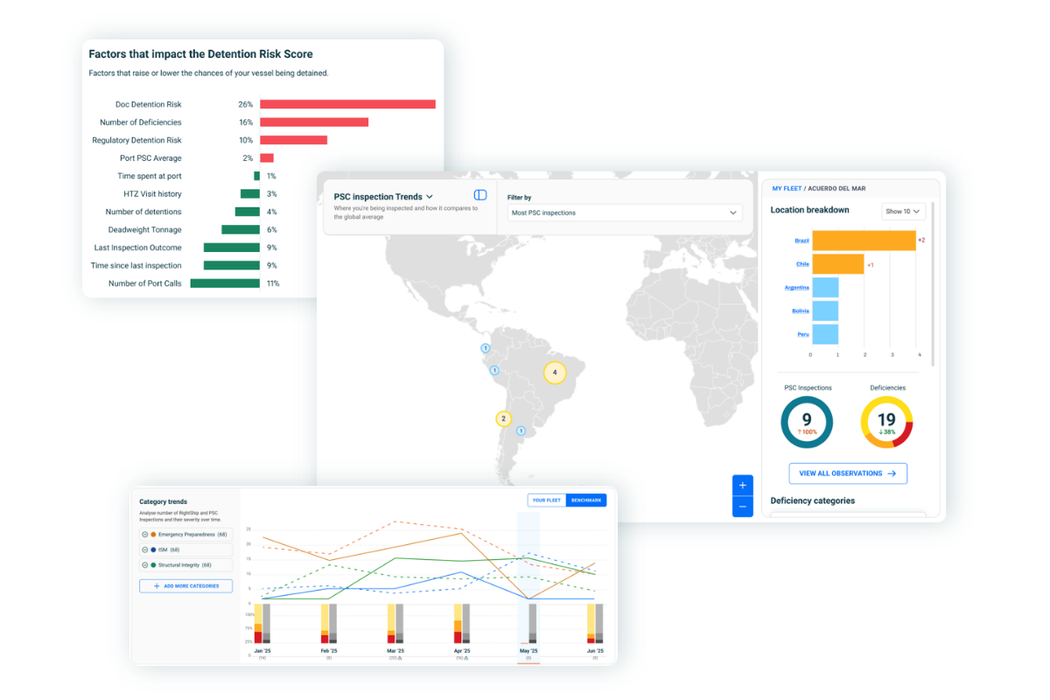
We focused on three main problems. First was data unification—bringing inspection data, PSC deficiencies, and incidents together and grouping them by meaningful themes like safety systems, environment, or machinery. Second was shifting the conversation from individual vessels to the fleet level, which is far more relevant for managers overseeing multiple ships. And third was trends and benchmarking—helping customers understand whether their efforts were actually improving outcomes over time, and how they compared against peers in a more nuanced way.
Q. Which pain points were non-negotiable when developing Fleet Focus?
Abhinav:
The biggest non-negotiable was helping customers move from data to decisions. We didn’t want to just show raw data—we wanted users to immediately spot trends and benchmark performance.
One customer told me they spent hours before every quarterly review manually categorising findings to understand where issues really sat. We baked that feedback directly into Fleet Focus, so customers can instantly see their top issue categories at fleet level.
Benchmarking was another critical area. Instead of generic comparisons, Fleet Focus allows customers to build custom comparable fleets, selecting the DOCs or operators they see as true peers—while still protecting individual data integrity by comparing against cohorts rather than single competitors.
Q. What upcoming Fleet Focus features are you most excited about?
Abhinav:
What we’ve released so far is really just the MVP. One of the most exciting areas we’re working on is identifying repeat deficiencies across different data sources—for example, linking an incident from months ago to a later inspection finding caused by the same systemic issue.
We’re also expanding insights across inspection performance and incident patterns, and developing downloadable reports that customers can use for both internal reviews and external reporting.
Q. What makes RightShip’s data uniquely valuable for Fleet Focus?
Abhinav:
RightShip’s inspection and incident data is incredibly deep, structured, and contextual. Every inspection is standardised, verified, and enriched with historical insight.
That means when Fleet Focus identifies a pattern, it’s grounded in verified data—not assumptions. If we say a machinery issue is recurring across similar vessels, that insight is backed by real evidence, which gives customers confidence to act.
Q. How did you unify inspections, PSC, and incidents into a single model?
Abhinav:
With great difficulty! But fundamentally, we built a common language of risk across data sources. Inspections, PSC findings, and incidents all tell parts of the same story about risk onboard vessels.
By aligning severity models and deficiency descriptions—and using AI to analyse root causes, corrective actions, and preventive actions—we were able to categorise issues consistently across datasets and surface meaningful fleet-level insights.
Q. Where does AI add the most value in Fleet Focus?
Abhinav:
AI excels at analysing millions of data points across different sources and turning them into understandable trends and patterns. We use AI to summarise issues, detect repeat patterns, and highlight where and why risks are emerging.
That said, AI is there to support human expertise, not replace it. All outputs are vetted and refined with input from our subject matter experts to ensure insights remain explainable, trustworthy, and actionable.
Q. How do human expertise and AI work together at RightShip?
Abhinav:
A great example is deficiency categorisation. AI helps analyse closeout reports to understand the nature of issues, but our Marine Excellence team reviews and fine-tunes the outputs. Their experience ensures the model reflects real-world maritime understanding.
AI saves time, but the judgment and decision-making remain firmly in human hands.
Q. Why was benchmarking such a critical part of Fleet Focus?
Abhinav:
Benchmarking needs nuance. Comparing raw deficiency counts without context—like trading patterns or severity—doesn’t give a fair picture.
Fleet Focus allows customers to benchmark by event type, category, and severity, normalising for trading patterns and highlighting high-risk issues. This means operators can have far more meaningful performance and commercial discussions.
Q. How are owners and managers using Fleet Focus to make better decisions?
Abhinav:
Fleet Focus helps managers prioritise limited resources. If issues are concentrated in a certain category, region, or vessel group, they can focus maintenance and corrective actions there.
Understanding what’s improving, what’s not, and where risks are emerging allows customers to turn insight into daily operational decisions.
Q. For teams new to fleet-level analytics, what’s the quickest path to value?
Abhinav:
In the first month, customers should notice how much time they save by replacing manual cross-checking with instant visibility. They get both a bird’s-eye view of fleet issues and the ability to drill down without pulling individual reports.
Within 90 days, we want customers to clearly see trends and understand whether corrective actions are working—and pivot quickly if they’re not.
Closing
Fleet Focus represents a shift in how ship owners and managers engage with safety and performance data—from fragmented, reactive analysis to connected, proactive decision-making.
As Abhinav explains, combining trusted data, explainable AI, and deep maritime expertise allows RightShip to deliver fleet intelligence that is not only powerful, but practical. And with Fleet Focus continuing to evolve as part of RightFLEET, this is just the beginning of what proactive fleet management can look like.
Want a quick tour of Fleet Focus? Watch our Fleet Focus navigation videos to see it in action.