
 About Us
 Offices
 Partnerships
 Meet the team
 Shipowner
 Charterer
 Ports & Terminals
 Financial
Learn how Hybrid Inspections blend remote review with focused onboard checks to save time, support crew welfare, and maintain a consistent, compliant process.
04 December 2025

Across the maritime industry, rising operational pressures and reduced port windows have made traditional inspections increasingly challenging to fit into tight schedules. While RightShip’s Hybrid Inspection model isn’t new, what is new is how much easier, faster, and more efficient it has become. By redesigning the preparation workflow and enabling a blended approach to document review, Hybrid Inspections now offer a more predictable experience for vessels, inspectors, and crew alike.
1. When Time in Port Is Limited, Every Hour Matters
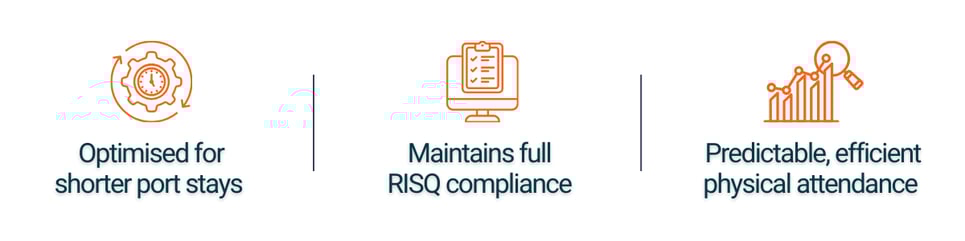
Many vessels today operate with port calls lasting 12 hours or less, making a full 12-hour standard inspection difficult to accommodate. The Hybrid Inspection model provides a practical alternative by reducing onboard time to approximately 8 - 10 hours, without compromising assessment validity or RISQ compliance.
With inspectors attending for essential verification and safety checks—but reviewing most documents beforehand—vessels can maintain their operational rhythm while still achieving a thorough inspection.
The hybrid advantage:
2. Less Onboard Stress: A Better Experience for Masters and Crew
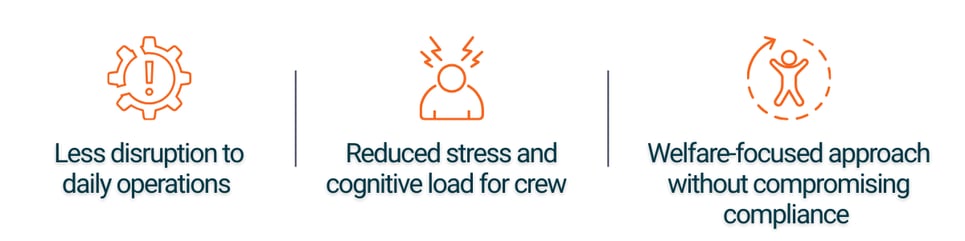
Inspection days can naturally interrupt the vessel’s workflow—crew members supporting document checks, routine duties pausing to provide files, and unexpected delays when paperwork is incomplete. Hybrid Inspections significantly reduce this burden.
By shifting most documentation review off the vessel, crew face fewer interruptions and can continue their operational duties with minimal disruption. While inspectors may still verify certain implementation elements onboard, the overall experience becomes calmer, clearer, and more manageable.
The hybrid advantage:
 Speaking about the impact on crew, Darren Ryan, Chief of Operations, said, "Our Inspections support crews to identify where safety and performance can be improved, for their safety and the performance of their vessel. At the same time, we also appreciate that crews are under pressure. The Hybrid model will help crews, by enabling Managers to provide documentation ahead of time for the Inspector to review. Which will allow for reduced time required on board, and allow crews to focus on managing other operations, or their rest hours, while still maintaining inspection quality."
3. Preparation = Efficiency: The Power of a Two-Stage Documentation Workflow
One of the most meaningful improvements to the Hybrid Inspection model is the streamlined documentation process, now divided into two clear and manageable stages:
✔ The majority of documents can be uploaded early via the Document Management Centre (DMC)
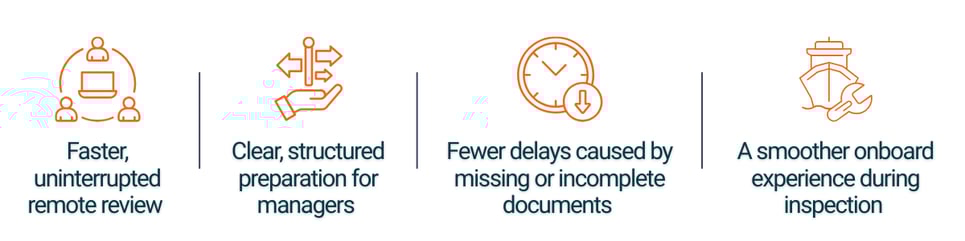
Most of the required documentation can be uploaded well in advance [approx. 70%] —often long before an inspection is even booked. Early submission allows inspectors to begin remote review sooner, increasing accuracy and reducing last-minute back-and-forth. These documents can also be reused across multiple inspections if they remain valid as defined by Class or regulatory requirements.
✔ The remaining, inspection-specific documents uploaded closer to attendance
A smaller portion of the documents is submitted once the Hybrid Inspection is booked [approx. 30%] — 72 hours before attendance. These items support final checks and allow inspectors to complete the remaining review in a structured and uninterrupted workflow.
The hybrid advantage:
 Reflecting on the redesign, Marlon Grech, Chief Technology & Product Officer, said, “When we examined the inspection process closely, we saw that a significant amount of onboard time was spent reviewing documents alongside the crew — a crew that is already stretched and often working long shifts. So we asked ourselves: why does this need to happen on the vessel at all? If ship managers upload the required documents upfront, our inspectors can review and validate them offline, reducing the workload placed on the crew and shortening the time we physically need to be on board. We tested this approach, and it works, without compromising inspection quality.”
4. A More Predictable, Modern Inspection Experience
The Hybrid model blends the best of both worlds: the thoroughness of a physical inspection and the efficiency of remote review. By front-loading preparation and reducing the need for extensive onboard document handling, the process becomes more predictable for all stakeholders.
What remains onboard is the part that matters most: verification, safety checks, and assessment of implementation—conducted in a focused timeframe with minimal disruption.
The hybrid advantage:

Looking Ahead
As the maritime industry continues to evolve, inspection models must evolve with it. Hybrid Inspections represent a smarter, more adaptable approach—one that respects operational pressures, improves crew experience, and delivers reliable compliance outcomes.
With clearer preparation steps, reduced onboard time, and a structured documentation process that separates what can be done early from what must be done closer to attendance.
It’s not just an inspection—it's a better way to prepare, a better way to operate, and a better way to support your crew.
That’s the Hybrid Advantage.