
From Pledges to Practice
Anchoring Safety, Sustainability, and Crew Welfare in Vessel Selection
The maritime supply chain is under mounting pressure to turn Environmental, Social, and Governance (ESG) promises into measurable progress. Commissioned by RightShip, this report examines the gap between industry ambitions on safety, sustainability, and crew welfare, and the realities of everyday commercial decision-making — highlighting what it will take to move from pledges to practice.

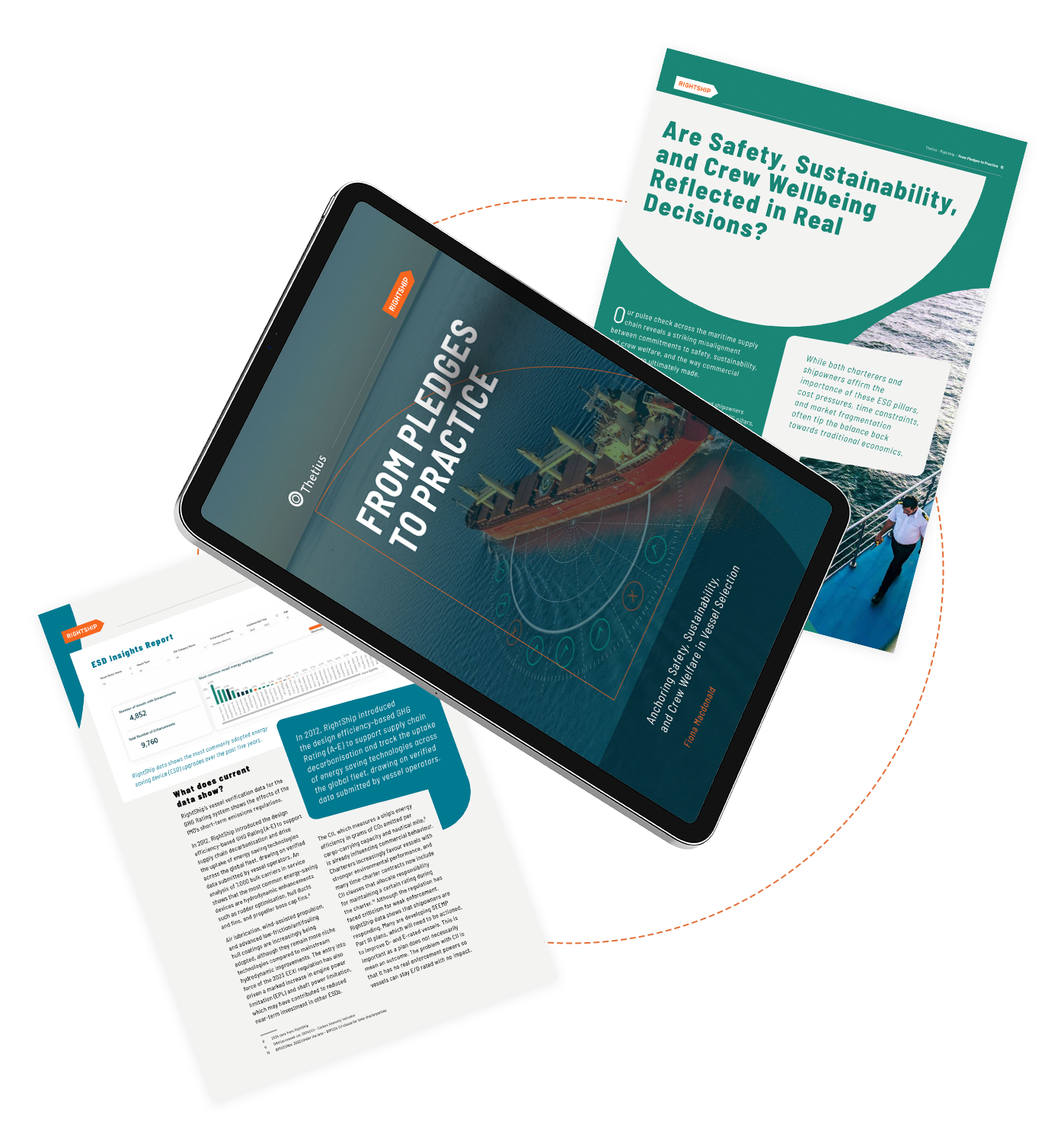
What’s in the report
Anchoring Safety, Sustainability, and Crew Welfare in Vessel Selection
We hosted a webinar to discuss the findings from our Pledges to Practices Report.
Watch as Christopher Saunders (RightShip), Prashanth Athipar (BHP), Torben Hertel (V.Ships), and Raymond Peter (BSM) — moderated by Nick Chubb (Thetius) — share their perspectives on how the industry can drive more consistent, transparent, and commercially viable recognition of higher standards.

Despite growing momentum for safety, sustainability, and crew welfare in the global maritime supply chain, our latest pulse check reveals a clear gap between ESG commitments and the realities of commercial decision-making. While both charterers and shipowners recognise the value of responsible, sustainable operations, cost pressures, time constraints, and market fragmentation continue to push decisions toward traditional economic priorities.
Framework for Change
To shift ESG from being a compliance obligation into a recognized driver of value, the industry needs a framework that makes leadership visible, comparable, and commercially relevant.
Download the report to uncover 4 actionable recommendations that bridge the gap between pledges and practices.
“Owners say pay me a premium for a greener vessel. Fine. But unfortunately, there is currently no global regulatory or commercial system in place for end customers to pay for the total life cycle emissions, including shipping emissions. So, it becomes our problem.”
“Nothing goes out unless the ship is safe. Safety is the first and foremost thing. We would prefer to keep a substandard or unseaworthy vessel at the anchorage and bear the freight cost than berthing the vessel, which could potentially lead to a major incident within the narrow channel or at one of our terminals / berths.”
“It is difficult to measure and monetise crew happiness, so owners treat it as a cost centre, not a competitive advantage. Future crew skill needs such as handling new fuels or digital systems may force a shift, but the incentive is talent retention, not charter rate premiums.”
“Charterers’ decisions are ruthlessly cost driven. A dollar a box difference can decide who gets the business. So shipowners may feel they’re investing in ESG, but unless that translates into direct value for the charterer, they won’t be rewarded. The key is value. What is the value of sustainability actions, and who are they valuable to? Once we understand that, rewards follow.”
Bridge the gap between ESG pledges and real-world practices
Turn safety, sustainability, and crew welfare into a competitive advantage.
%20(3).png?width=852&height=252&name=RightShip_Logo_RGB%20(1)%20(3).png)